
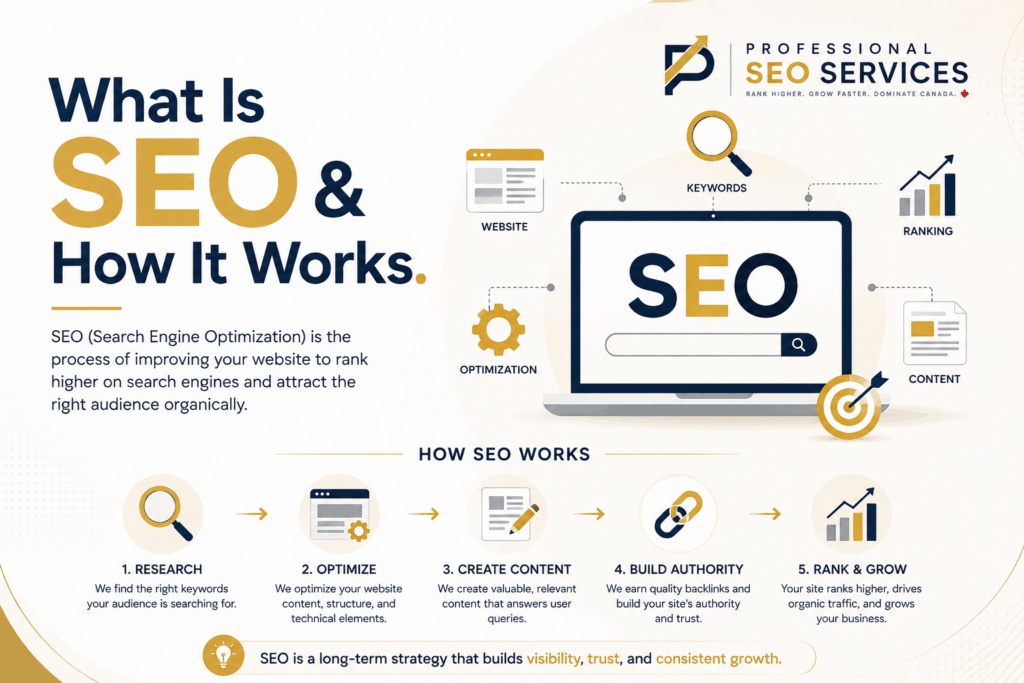
Search Engine Optimization (SEO) is the practice of improving a website so that search engines like Google can find, understand, and rank it higher for the terms people actually search. In simple terms, SEO is how a business becomes visible to someone who is already looking for what it offers, without paying for that visibility through ads.
At Professional SEO Services, this is the foundation everything else is built on. Before you dive into keyword research, backlinks, or technical audits, it helps to understand why SEO works the way it does, because every tactic that follows in this blog exists to serve one of the three processes explained below: crawling, indexing, and ranking.
Why SEO Matters for a Business
Search engines are the starting point for most buying decisions today. If your website isn’t visible when a potential customer searches for your product, service, or industry, that customer finds a competitor instead. Unlike paid ads, SEO builds visibility that compounds over time, once a page ranks well, it can keep generating traffic and leads for months or years without an ongoing ad spend.
For a Canadian business specifically, this also means competing in local search results, something we cover in depth in our local SEO services.
How Search Engines Actually Work
To understand how SEO works, you first need to understand what a search engine is doing behind the scenes. Every major search engine, Google, Bing, or otherwise, runs on three core processes:
1. Crawling
Search engines use automated programs called “crawlers” or “spiders” (Google’s is called Googlebot) that travel across the web by following links from one page to another. Crawling is how a search engine discovers that a page exists in the first place. If a page has no internal or external links pointing to it and isn’t submitted through a sitemap, a crawler may never find it.
2. Indexing
Once a page is crawled, the search engine analyzes its content, text, images, structured data, and page structure, and stores that information in a massive database called the index. Only pages that are indexed are eligible to appear in search results. A page can be crawled but still excluded from the index if it’s low-quality, duplicate, or blocked by a noindex tag.
3. Ranking
When someone types a search query, the search engine doesn’t search the live web in real time, it searches its index and runs the matching pages through a ranking algorithm. This algorithm evaluates hundreds of signals to decide which pages best answer the query, then orders them on the search engine results page (SERP).
This three-step process, crawl, index, rank, is the entire mechanical foundation SEO is built to influence.
The Ranking Factors That Decide Who Wins
Google has confirmed it uses hundreds of ranking signals, but they generally fall into a few major categories:
- Relevance – Does the page’s content actually match the intent behind the search query?
- Content quality and depth – Does the page comprehensively answer the topic, or just skim the surface?
- Expertise, Experience, Authoritativeness, and Trustworthiness (E-E-A-T) – Is the content created by someone with real knowledge or experience, and is the source trustworthy?
- Backlinks – Do other credible websites link to this page as a reference?
- Technical health – Does the site load quickly, work on mobile, and have no crawl errors?
- User experience signals – Do visitors stay, engage, and find what they need, or bounce straight back to the search results?
No single factor guarantees a top ranking. Google’s algorithm weighs all of these together, which is why SEO is treated as an ongoing discipline rather than a one-time fix.
The Three Pillars of SEO
Every SEO strategy, including the ones we run for our clients, breaks down into three interconnected disciplines. Understanding how they work together is what separates a real SEO strategy from a scattered list of tactics.
On-Page SEO
On-page SEO covers everything you control directly on your website: page titles, headings, content quality, internal linking, image optimization, and how well a page matches search intent. This is where relevance is built. Read our full breakdown in On-Page SEO Services.
Off-Page SEO
Off-page SEO covers signals earned outside your own website, primarily backlinks from other credible sites, brand mentions, and digital PR. This is where authority is built, because search engines treat links from reputable sites as a vote of confidence. See how we approach this in Off-Page SEO & Link Building.
Technical SEO
Technical SEO covers the infrastructure that allows crawling and indexing to happen properly in the first place — site speed, mobile-friendliness, secure connections (HTTPS), structured data, XML sitemaps, and clean site architecture. A site can have great content and strong backlinks and still fail to rank if the technical foundation is broken. More detail here: Technical SEO Services.
Local SEO: A Fourth Pillar for Local Businesses
For businesses that serve a specific city or region, a dentist in Calgary, a roofer in Mississauga, a law firm in Toronto, there’s a fourth layer: local SEO. This involves optimizing your Google Business Profile, building local citations, and targeting geo-specific keywords so you show up in the “map pack” and local results when someone nearby searches for your service. We break this down further in Local SEO Services.
How Long Does SEO Take to Work?
SEO is not instant. Because it relies on search engines crawling, indexing, and then re-evaluating rankings over time, most websites start seeing measurable movement within 3 to 6 months, with stronger results building over 6 to 12 months, especially in competitive industries. This is different from paid search, where visibility stops the moment you stop paying.
SEO vs Paid Advertising
It’s worth clarifying this distinction, since it’s one of the most common points of confusion:
| SEO | Paid Ads (PPC) | |
|---|---|---|
| Cost model | No cost per click | Pay per click |
| Speed | Slower, builds over months | Immediate visibility |
| Longevity | Traffic continues after the ranking is earned. | Stops when budget stops |
| Trust | Often seen as more credible by users | Clearly labeled as an ad |
Most mature SEO strategies use both paid ads for immediate visibility and SEO for sustainable, compounding growth.
Getting Started With SEO
If you’re evaluating where to begin, start with a technical and content audit of your current site, this tells you exactly what’s blocking crawlers, what’s missing from your content, and where your competitors are outranking you. That’s the starting point of our own process; you can request one through our SEO Audit service.
Frequently Asked Questions
What does SEO stand for?
SEO stands for Search Engine Optimization, the practice of improving a website to increase its visibility in organic (unpaid) search engine results.
Is SEO a one-time task or ongoing?
SEO is ongoing. Search algorithms update constantly, competitors keep publishing new content, and rankings shift accordingly, which is why SEO is treated as a continuous strategy, not a single project.
Can I do SEO myself, or do I need an agency?
Basic on-page SEO can be done in-house, but technical SEO, competitive link building, and scaling content across a topical map typically require dedicated expertise and tools – which is where a professional SEO service adds the most value.
What’s the difference between SEO and SEM?
SEO focuses only on organic (unpaid) rankings, while SEM (Search Engine Marketing) is the broader umbrella that includes both SEO and paid search advertising.
Written and reviewed by the SEO team at Professional SEO Services, a Toronto-based SEO agency helping Canadian businesses improve organic visibility and rankings.
