
Choosing an SEO agency is a business decision, not simply a marketing purchase.
A good agency should be able to explain what it plans to improve, why those changes matter, how success will be measured, and what evidence supports its strategy.
A weak agency can make almost any SEO package sound impressive. It can promise hundreds of backlinks, publish a fixed number of articles every month, provide ranking reports, and show impressive-looking charts without ever demonstrating whether the work is producing qualified traffic, leads, customers, or sustainable search visibility.
Before signing a contract, ask the questions below.
The goal is not to find an agency that gives the most complicated answer. The goal is to find an agency that can give you a clear, specific, and commercially sensible answer.
Why this matters
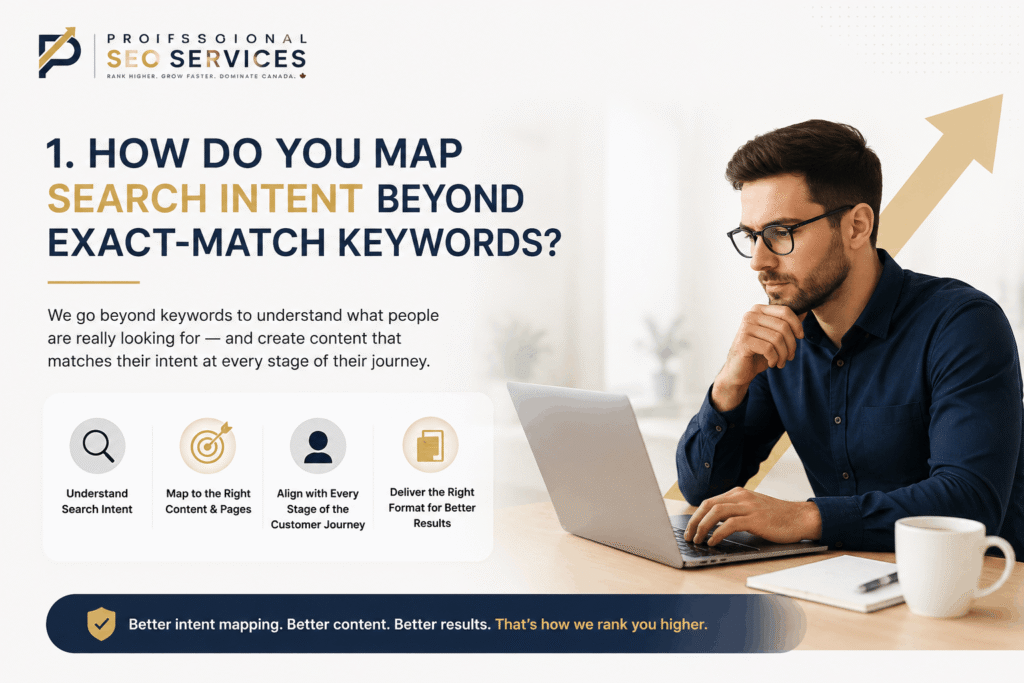
Search visibility is not simply about finding a list of words and inserting them into pages.
A serious SEO strategy should consider what people are actually trying to accomplish when they search, how that intent changes throughout the buying journey, and what type of result best satisfies that intent.
Two searches can contain similar words while representing completely different needs.
A strong agency should be able to explain how it studies search results, competitors, customer journeys, SERP features, related topics, and the underlying intent behind search demand.
A weak answer sounds like:
“We select the most searched keywords in your industry and optimize your pages around them.”
A stronger answer sounds like:
“We analyze the intent behind the search demand, examine the current search results, group related queries by purpose, and map the right pages and content formats to each stage of the customer journey.”
What to ask next
Ask the agency to show you one real example of how it would turn search demand into a page or content strategy for your business.
Why this matters
High search volume does not automatically mean high business value.
A term can have thousands of searches but produce very few qualified customers. Another term may have much less volume but closely match the people most likely to buy.
A good agency should consider factors such as:
Red flag
Be cautious if an agency focuses almost entirely on search volume, keyword difficulty, or a fixed number of keywords without explaining how those opportunities connect to your business.
Why this matters
Modern SEO is not just about optimizing individual pages.
Your website needs a logical relationship between important pages, supporting content, internal links, categories, products or services, and the subjects your business is genuinely authoritative on.
A strong agency should be able to explain:
A weak answer sounds like:
“We’ll publish more blog posts every month to increase your keyword footprint.”
A stronger answer sounds like:
“We’ll identify the topics and search needs that matter to the business, map them to the right URLs, strengthen relationships between related pages, and create new content only where it serves a defined purpose.”
Why this matters
A technically impressive website can still have search visibility problems if important content is difficult to crawl, render, discover, or index.
An experienced agency should be able to investigate:
The key question is not whether an agency uses an expensive crawling tool. It is whether the agency can interpret what the tools reveal and connect technical findings to actual search problems.
Ask this:
“Can you show me an example where a technical issue was identified, diagnosed, fixed, and then validated?”
That answer will tell you much more than hearing a list of software names.
Why this matters
JavaScript-heavy sites can introduce additional technical considerations. The issue is not that JavaScript automatically creates an SEO problem. The issue is whether the content and links that matter can be properly discovered, rendered, and processed.
This is particularly relevant for websites built with modern frameworks or sites that depend heavily on client-side functionality.
Ask this:
“How do you determine whether JavaScript is actually causing a crawl, rendering, or indexing issue on our site?”
A strong answer should focus on:
Diagnosis first, evidence second, implementation third.
An agency should not recommend a complicated technical rewrite simply because a website uses React, Angular, Next.js, Shopify apps, or another modern technology.
Why this matters
Performance work should not stop at “compress your images.”
A capable technical SEO team should understand the causes of poor responsiveness and loading performance and know how to work with developers when the solution requires code-level changes.
Ask how the agency identifies:
Be cautious when an agency promises to “fix page speed” using only a caching plugin or image compression without investigating the underlying bottlenecks.
Why this matters
A monthly article quota does not automatically equal an effective content strategy.
The important question is not:
“How many blog posts will you publish?”
It is:
“Why does each piece of content need to exist?”
A strong content process should consider customer questions, search intent, business expertise, existing website coverage, competitive gaps, product or service relevance, and opportunities to strengthen important pages.
Ask this:
“Can you show me how you would decide whether a new article should be created, whether an existing page should be improved, or whether two pages should be consolidated?”
That question separates a strategy-led agency from a content production service.
Why this matters
Content should provide a reason for the user to choose your page over the alternatives.
Ask about:
Red flag
Be cautious if the agency’s primary selling point is how many words it can produce every month. More content is not automatically better.
Why this matters
SEO is not always about creating another page.
Sometimes the correct action is to improve an existing page. Sometimes pages should be consolidated. Sometimes a page has no meaningful purpose and should be removed, redirected, or otherwise handled appropriately.
Ask the agency how it identifies:
A stronger question:
“How do you decide whether a page should be improved, differentiated, consolidated, redirected, or left alone?”
Why this matters
Many agencies have added “AI SEO,” “GEO,” or “AEO” to their service pages without explaining what they actually do.
Do not hire an agency because it uses the latest acronym.
Ask for the actual work.
A credible answer should connect AI-search visibility to solid fundamentals such as:
Red flag
Be extremely cautious of anyone promising:
“We can guarantee that ChatGPT will recommend your company.”
or:
“We have a secret AI ranking formula.”
No serious agency can guarantee that a third-party search or generative system will mention a brand in a particular response.
Why this matters
“AI optimization” becomes meaningless if nobody can explain how it is evaluated.
Ask what the agency actually measures and how it separates meaningful visibility from vanity metrics.
Depending on the business, useful evaluation may include:
Ask this:
“Which AI-search metrics would cause you to change our strategy?”
A good agency should be able to answer this without hiding behind a dashboard full of meaningless numbers.
Why this matters
A large backlink number can look impressive while contributing very little to a site’s long-term authority.
Ask how the agency evaluates potential referring domains.
Questions worth asking include:
Red flag
Be very cautious of:
“Guaranteed 50, 100, or 200 high-DA backlinks every month.”
A fixed link quota can encourage agencies to pursue quantity instead of quality.
Why this matters
You should know what is being built in your brand’s name.
Depending on the campaign, you may want visibility into prospective publishers, outreach targets, or placements before they go live.
Ask:
“Can we review the target site before the placement happens?”
Also ask:
“What do you do when a site technically meets your metrics but does not make sense for our brand?”
The second question is especially revealing.
Why this matters
Your agency is effectively acting on behalf of your brand.
You need to understand whether its acquisition methods are consistent with the risk level your business is willing to accept.
Do not be satisfied with vague phrases such as
“We use a proprietary network.”
Ask the agency to explain where links come from, how sites are selected, and what role editorial judgment plays in the process.
Why this matters
Ranking reports are not the same as business reporting.
A keyword moving from position 18 to position 9 may be useful, but the real question is whether search visibility is generating commercially meaningful outcomes.
Ask the agency how it will connect organic search with:
A stronger answer sounds like
“We establish conversion tracking and reporting that connect organic landing pages and search visibility to the business actions that matter, then use that data to influence our strategy.”
Why this matters
This is one of the most useful questions you can ask.
A strategy should not continue forever simply because an agency has a contract.
Ask:
“What would cause you to stop, change, consolidate, or redirect an SEO initiative?”
A strong agency should be willing to explain what evidence would trigger a strategic change.
Be cautious if the answer is essentially
“SEO takes time, so we just need to keep going.”
Time is sometimes necessary. But time by itself is not a strategy.
Why this matters
The person selling the strategy may not be the person executing it.
Ask:
You are not necessarily looking for an agency that does every task in-house. You are looking for an agency that is transparent about who is responsible for the work.
Why this matters
“Full-service SEO” can mean almost anything.
Before signing, ask for a concrete explanation of monthly deliverables.
That could include:
Avoid judging an agency solely by the number of deliverables. A smaller number of high-impact improvements can be more valuable than a large checklist of low-value activities.
Why this matters
Make ownership clear before work begins.
Ask who owns:
You should understand what happens to those assets if the relationship ends.
Why this matters
A good SEO relationship should not depend on keeping the client trapped.
Ask:
“What happens to the work, content, accounts, reports, and other assets if we stop working together?”
Also review:
Read the contract before assuming the answer.
Why this matters
A case study is most useful when it is relevant.
Ask for examples that resemble your business in areas such as:
Do not focus only on the biggest percentage increase.
Ask:
“What changed, what did you actually do, and over what period?”
You do not need to ask an agency fifty questions during the first call.
Start with these:
This tests whether the agency has actually investigated your business.
This tests judgment.
This tests strategy.
This tests commercial thinking.
This tests accountability.
This tests transparency.
This tests operational reality.
Be cautious when an agency:
One red flag alone does not prove that an agency is bad. A pattern of vague promises, rigid deliverables, poor transparency, and weak measurement should make you pause.
Before hiring an agency, you should understand:
What is the business opportunity?
What problems are currently limiting search performance?
Which pages and topics matter most?
What work will be performed?
Why is that work being prioritized?
How will progress be measured?
How will SEO connect to business outcomes?
How will the strategy adapt when the data changes?
If an agency cannot explain those things clearly, a larger package is unlikely to solve the problem. The best SEO engagement is not the one with the most keywords, the most articles, or the most backlinks.
It is the one where the agency can clearly explain what it is doing, why it is doing it, how it will know whether it worked, and what it will do next when the evidence changes.
Use this checklist before signing an SEO contract:
SEO is a long-term investment in a website’s ability to be discovered, understood, trusted, and chosen.
The right agency should not need to impress you with jargon.
It should be able to show you a logical path from business goals → search demand → website improvements → useful content → authority → qualified search visibility → measurable business results.
That is the standard worth using before you hire an SEO agency. If you’re ready to move beyond rankings and build an SEO strategy focused on qualified traffic, leads, and sustainable growth, talk to Professional SEO Services Canada today.
Have any confusion or ready to grow your business rankings? Fill out the form or contact our support team, and let’s discuss your project in detail.

Usman AK is a Content Strategist at Professional SEO Services (PSS) Canada, specializing in developing clear, search-focused content strategies that align business goals with user intent. He works on creating and refining website content, researching relevant search topics, and ensuring each piece provides genuine value while supporting long-term organic growth.