
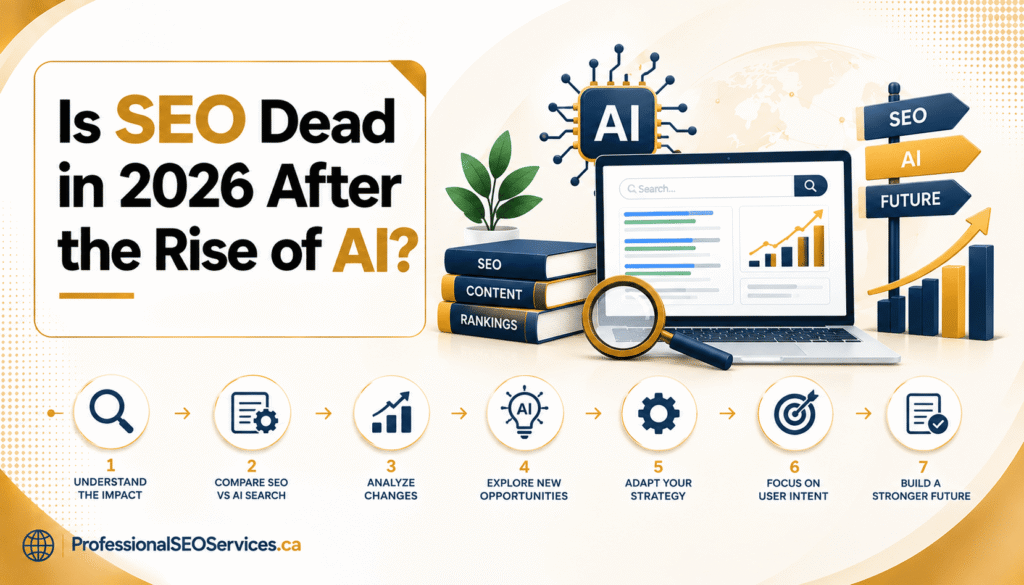
Businesses who are wondering, “Is SEO dead in 2026”: the short answer is no, SEO isn’t dead. But the SEO built with generic low quality content and random keyword volume is over. Now the number of clicks has reduced significantly after Google introduced AI Overviews. Yet, businesses still get customers on commercial, local, and comparison searches. Today, we will explain in this blog whether SEO is dead, the future of SEO, and debunk lots of myths you must have heard.
Key Takeaways
- Semrush tracked 10 million keywords and found AI Overviews appearing on 6.49% of queries in January 2025. Eventually, that number peaked near 24.6% in July 2025, then settled to roughly 15.7% by November 2025. AI Overviews show up mostly in informational searches.
- According to Pew Research Center’s March 2025 study, users clicked a traditional result just 8% of the time when an AI Overview appeared, versus 15% without one. But only 1% clicked a link inside the AI summary itself.
- The generic summaries usually cannot conclude the commercial, local, and comparison searches because users need specific, current business information.
- The tactics that are drying includes poorly written content, keyword stuffing, and bulk low-quality link building, not SEO as a discipline.
Why This Question Keeps Coming Up: “Is SEO Dead in 2026”?
You can get an idea of the panic when people are constantly searching “Is SEO Dead in 2026” on search engines. Google launched AI Overviews in its 2024 update, and businesses noticed a dip in their traffic analytics. But the huge drop in traffic doesn’t always mean a drop in customers. All the failing businesses have one thing in common: they target top-funnel informational content in their strategies. But this is the exact category AI Overviews have absorbed. When businesses fail after doing SEO, they start searching is SEO dead in 2026, but the reality is it’s not, its updated.
What the Data Actually Shows About SEO
Most trusted service on the internet, SEMrush’s study of over 10 million keyword analyses shows AI Overview prevalence climbing from 6.49% of queries in January 2025 to a peak near 24.6% in July, before settling back to about 15.7% by November 2025. This means roughly 5 out of 6 searches on Google do not show AI Overviews.
Separately, Pew Research Center’s study tracked actual browsing behaviour from 900 US adults across nearly 69,000 real Google searches. After users search for something and an AI Overview shows up, they click organic results only 8% of the time, which is half of compared to 15% without an AI Overview. The more shocking thing is that only 1% of users click the source cited inside an AI Overview.
So, the question “Is SEO Dead in 2026” is valid. You can see this pattern repeating across all the independent research that AI Overviews concentrate heavily on informational queries. The searches, for example, “what is” and “how does,” rarely brings an organic traffic to your site, because most users prefer AI Overviews.
The Myth vs. The Reality: Is SEO Dead in 2026 After AI or Not?
After this new age of AI, everyone’s worried about their business growth and rankings on top searches, asking Is SEO dead in 2026? But the fact is, SEO is still alive and effective when done right. Here are a few myths and their reality:
| Myth | What the Data Actually Shows |
| “AI tools invent their own answers instead of pulling from real sites” | A 370,000-result analysis found 94% of AI citations on Bing and GPT-backed tools still come from pages already ranking in the traditional top 10 |
| “Being on page one doesn’t matter for AI visibility” | The same study found the top 5 organic results alone capture 76–81% of AI selections — ranking position still drives citation odds |
| “AI Overviews have taken over most searches” | Semrush’s research puts AI Overview appearances at roughly 16% of queries, leaving the large majority of searches unaffected |
| “Organic traffic only declines after AI search tools launch” | Campfire Labs found several leading software companies grew organic traffic by 17.5% or more post-ChatGPT, through strong localization and content depth |
What’s Actually Dying (And What’s Replacing It)
You should not scroll for “is SEO dead in 2026”; instead, worry about what’s actually taking its last breath. Targeting high search volume terms and writing thin blogs to capture informational traffic is over. Because the first thing AI Overviews steals from users is informational content. The next thing that is dying is keyword-stuffed pages, spun near-duplicate pages, and low-quality link-buying schemes. All these were already declining even before the rise of AI.
Reporting on raw session counts as the primary success metric is fading too, since a falling traffic line can mask a stable or rising revenue line when the lost clicks were never going to convert anyway.
Instead of searching whether SEO is dead in 2026, start searching what’s coming and track the latest updates from search engines. The things replacing all the above factors include: fewer, stronger pages backed by real proof, and content structured to be easy to understand for both humans and machines are getting ranked. Reporting anchored to leads and revenue rather than visits drives consistent results instead of targeting cheap content strategies.
What Still Works After the Rise of AI Overviews and Conversions?
Businesses have more stuff to research; is SEO dead in 2026? The top things that still work in SEO after the rise of Ai includes:
Content Built on Real Expertise
Do not waste your time on generic informational blogs, as AI Overviews replace them. Write original case studies, first-hand experience, and a clear point of view that buyers can show their trust. You have to outrank your competition on Google searches, so make sure your content weighs more in facts, latest information, and up-to-date data.
Local SEO
Someone searching “plumber near me” or “SEO agency in Toronto” still sees a map pack, and the same complete profile, consistent citations, and steady reviews that earn that spot also feed how AI assistants recommend local businesses. See [Internal Link: Local SEO Services] for how this plays out for Canadian service businesses specifically.
Technical Structure
When you make it easy for Google crawlers and AI chatbots to track your page content through clear heading hierarchies, you get more citations. A properly formatted page ensures crawlability and direct answers place your site on top of searches. Get a “Free” Site SEO Audit.
Verifiable Authority
Find more credible backlinks, mentions, and citations for your site growth; they are still worth quoting from content worth ignoring. It helps you in both technical site rankings and models generating AI answers such as ChatGPT or Claude. These AI tools pull their data from local directories and places where you build most of your backlinks.
The Bottom Line
The final answer to ” Is SEO dead in 2026, remains the same: SEO is not dead after the rise of AI Overviews. In fact, most business claims they are getting more organic customers without spending huge budgets on PPC campaigns or social media marketing. It all depends on the SEO strategies you are targeting on your site and how well you know site optimization.
Not sure how to rank your website in the local or international market? Get in touch with ProfessionalSEOServices.ca, offering SEO services across Canada.
Frequently Asked Questions
Is SEO still worth investing in for a Canadian business in 2026?
Yes, commercial and local searches still route real buyers to websites, and the same optimization work now also determines whether AI tools cite and recommend a business. So, rather than searching on Google (is SEO Dead in 2026), start targeting the best SEO strategies like link building, high-quality content structure, and optimizing your site technically.
Why do people keep saying SEO is dead?
Because the traffic decline is real and visible on informational queries, where Pew Research found click rates roughly halve when an AI Overview appears, but that decline is concentrated, not universal.
Is local SEO affected by AI Overviews the same way as blog content?
No, local SEO remains one of the least disrupted areas, since map pack results and AI local recommendations both rely on the same profile, review, and citation signals that have always mattered.
