
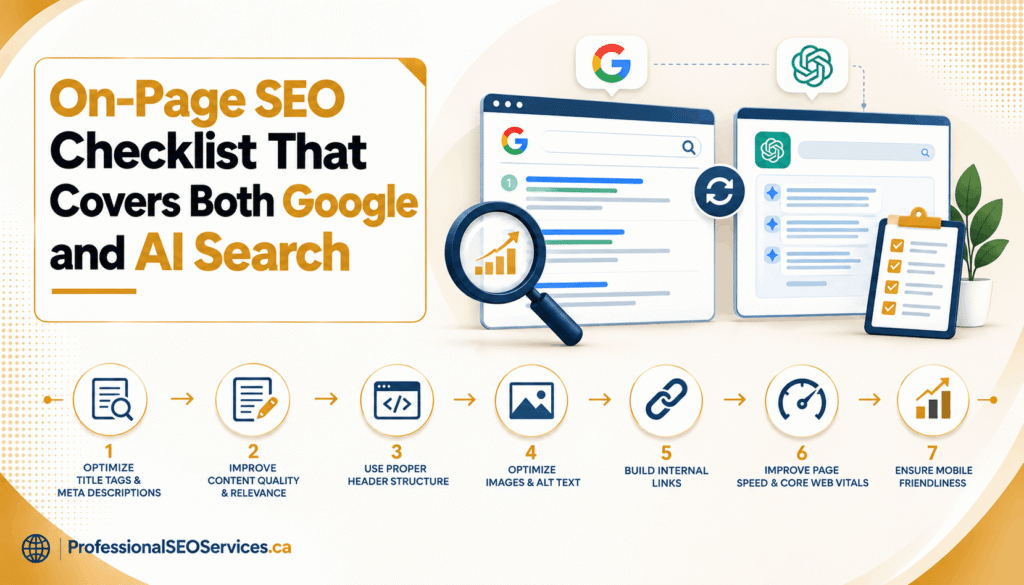
Most on-page SEO checklists were written to rank on one platform: Google. But now you have to outrank your competitors on AI tools like ChatGPT, Claude, and Google’s AI Overviews too. Despite, on-page SEO checklist has been updated compared to recent years, the fundamentals are still the same. Today, we are going to explore what actually matters for a successful website on-page SEO.
Why On-Page SEO Checklist Now Serves Two Systems at Once
For many years, on-page SEO has been helping Google crawl easily on the pages. That stays the same, but AI algorithms are extracting, summarizing, and citing data through easy on-page SEO in their generated answers. Through clear descriptive tags, a clear heading structure, and naturally placed keywords, AI tools and Google are able to collect the right content to add citations.
Start With Keywords That Match Real Intent
The first step of an on-page SEO checklist is to always match the targeted keywords to the user intent (what they are actually searching). The search intent is generally split into four main types, including:
- Informational for learning.
- Navigational for finding a specific site.
- Commercial for comparing options.
- Transactional for those who want to buy something.
A broad, high-volume term often carries stiff competition from national brands; a more specific variant tied to your city or service tends to convert better and rank faster for smaller sites. With AI search, you have to define the user search intent explicitly. This is where systems break a query into multiple subtopics, which is called query fan-out. As a result, the AI algorithms reward pages that properly cover a topic and its related questions, not just single exact-match phrases.
Title Tags: Still the Most Important On-Page Element
Capture the primary keyword in your title tag, preferably in the beginning, while describing the page accurately. Additionally, it’s an important on-page SEO checklist that you keep your titles under 60 characters, avoiding truncation in search results. Never duplicate the same titles across multiple pages; make every title unique for better content representation; do not confuse crawlers.
One H1, Written for Both Readers and AI Crawlers
Moving on to this on-page SEO checklist, keep a maximum of one H1 in your content. Microsoft’s research shows that Bing’s AI feature uses H1 headings to interpret what is the purpose of the page. That’s why keep your seed keyword at the start of your H1 and nicely explain the purpose of your page in it. A headline that overpromises undermines both user trust and AI confidence in the source.
Meta Descriptions: Not a Ranking Factor, But Still Worth Getting Right
Meta descriptions don’t directly influence Google rankings, but a well-written one increases click-through rate and gives AI tools useful context when citing your page. Keep it under roughly 105 characters, mention what the page delivers, and include the target keyword naturally rather than forcing it in.
URL Slugs: Short, Descriptive, Keyword-Aware
Google prefers simple and descriptive URLs over long slugs. While making slugs for your pages, skip filter words like “and” or “the,” and avoid embedding dates that will make the URL feel stale later. Instead, you can add hyphens between every word. Additionally, whenever you change your published slugs, make sure to add redirects, dont lose existing rankings or create broken links.
Body Content: Answer the Question Immediately
Next in line for best on-page SEO checklist, never ignore your content body while doing SEO. The on-page SEO practices work the same for both traditional and AI searches. Answer a heading raised first before adding background or nuance. This structure helps human readers scan efficiently and gives AI systems a clean, self-contained passage to extract and cite.
| Element | Best Practice |
| Title tag | Primary keyword near the start, under ~60 characters |
| H1 | One per page, matches title’s intent, accurate to content |
| Meta description | Under ~105 characters, includes keyword naturally |
| URL slug | Short, hyphenated, descriptive, no unnecessary dates |
| Body content | Direct answer immediately under each heading |
Structure Content So Machines Can Extract It
The overall structure of content matters more when you follow this on-page SEO checklist for your pages. Add clear headings from H1 to H6. Target every section on a single topic and write sensible paragraphs without confusing your readers. Especially for AI searches, the readability of your pages matters far more so your site can be cited in AI tools like Gemini, Claude, Bing, or Google’s AI overviews.
Internal Linking Builds Topical Authority
When you connect your pages with relevant internal links, this helps your site in two ways: answering users’ queries and signaling expertise to Google. You should use descriptive text rather than adding generic words like “Click Here”. A cluster of genuinely related content, properly interlinked, also strengthens the odds that AI tools recognize your site as a credible source on that topic.
Images, Video, and Schema: The Supporting Cast
More important stuff you should consider improving while focusing on this on-page SEO checklist includes optimizing:
Images & Video
You need to add relevant visuals that improve consumers’ understanding, accessibility, and page engagement.
- Add descriptive alt text to meaningful images.
- Compress images to improve page speed.
- Place visuals near the content they support.
- Use videos that match the page’s search intent.
- Host videos on YouTube for wider discovery.
Schema Markup
Having structured data increase chances of getting ranked in search engines because both crawlers and readers understand it easily.
- Add relevant schema markup to the page.
- Use suitable types such as FAQ, Product, or Article.
- Keep structured data accurate and up to date.
- Use schema to clarify important page information.
Don’t Skip the Technical Basics
On-page work can’t compensate for a robots.txt file accidentally blocking crawlers, including AI-specific bots. You cannot skip the technical SEO checklist while performing the on-page SEO checklist; that’s why:
- Avoid blocking important pages with “Disallow” rules.
- Keep pages fast and mobile-friendly.
- Ensure content works well on mobile devices.
- Fix technical issues that limit search and AI visibility.
This Checklist for on-page SEO makes your page format look good and readable, just like a local SEO checklist increases your domain’s authority and builds trust.
Common Mistakes to Avoid in Checklist for On-Page SEO
You should always avoid keyword stuffing in titles, headers, or the content body and keep them naturally placed throughout. That’s part of the on-page SEO checklist; avoid these mistakes as well:
- Duplicating meta descriptions or title tags across multiple pages
- Burying the answer to a heading’s question several sentences down instead of leading with it
- Skipping alt text on meaningful images, losing both accessibility and a ranking signal
- Leaving robots.txt misconfigured after a site migration or redesign
Where to Start
Optimize your page’s H1, title tags, meta description, and whole content structure first, because these carry the most weight in an on-page SEO checklist. Answer relevant public questions one by one and add proper internal linking for both user help and Google’s trust and expertise (EEAT). Whether you need full site SEO services or want to fix on-page SEO issues on your website, checkout ProfessioinalSEOServices.ca.
Frequently Asked Questions
What’s the most important item on an on-page SEO checklist?
The title tag remains the single most important element in an on-page SEO checklist that you cannot ignore and which directly impacts how search engines and users see your pages.
Does on-page SEO affect visibility in AI search tools like ChatGPT?
Yes, clear structure, descriptive headings, and direct answers under each subheading make it easier for AI systems to extract and cite a page’s content in generated responses.
How is a 2026 on-page SEO checklist different from older versions?
The core elements are unchanged, but AI-specific factors now matter alongside them: self-contained paragraphs, accurate H1 tags for AI interpretation, and robots.txt access for AI crawlers are now part of the same checklist rather than a separate concern.
