
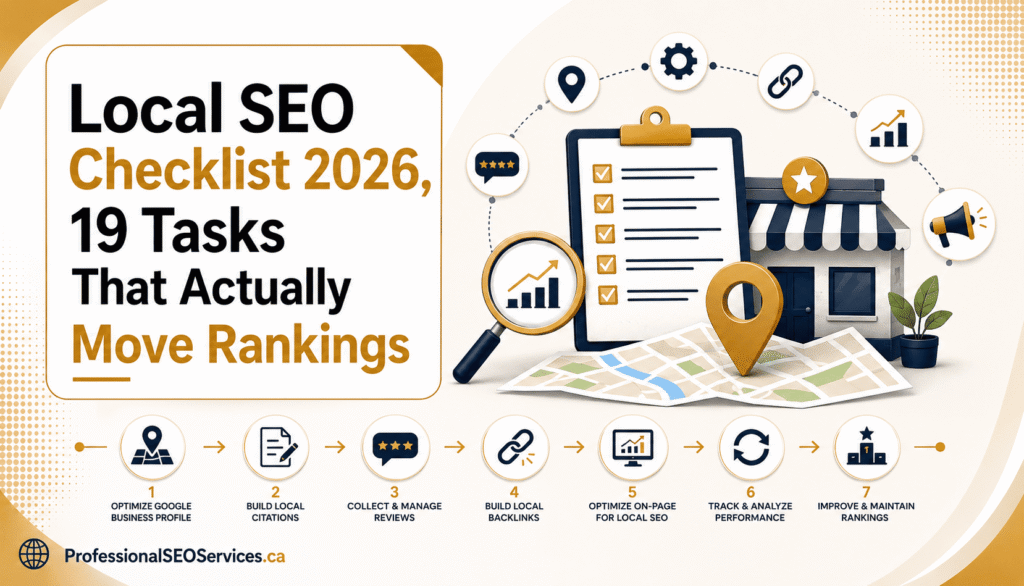
Most local SEO checklists on the internet are 60 times as long, and half of them are irrelevant after new updates. This local SEO checklist for 2026 is obviously shorter and covers everything which ir required to rank in top searches. What industry’s most citied researches show and what Google confirms about local SEO practices, we gather all in one place for Canadian businesses.
Why Order Matters More Than Length
For a great local SEO checklist, you need to follow all the strategies in the right order. Local rankings depend on three major factors, which are explicity approved by Google:
- Relevance
- Distance
- Performance
There is not much to do in distance, but you can make a huge difference in relevance and performance using our local SEO checklist properly. The common problem with most checklists for local SEO is that they list 50+ tasks with no sense of which ones carry weight. That’s why businesses end up wasting their time on citation submissions while their Google Business Profile is still incomplete.
Whitespark’s 2026 Local Search Ranking Factors research weights different strategies based on their important for the right local SEO practices in categories:
- Google Business Profile carries the most weight
- Then come on-page SEO signals
- Positive review signals
- Valid backlink signals
- User behavior signals
- Lastly, local citation signals
This is the order we follow in our comprehensive local SEO checklist for Canadian Businesses.
Pillar 1: Google Business Profile (Do This First)
The first thing we list in our local SEO checklist for you to follow is optimizing your Google Business Profile immediately. You can work on this sequence for good results:
Claim and Verify
An unverified profile can’t be trusted or fully edited. Verify before touching anything else.
Set your Primary Category with Precision
Primary category in your GBP consistently ranks as one of the top two or three direct signals to search engines. In category selection, specificity always wins. For example: A “plumber” outranks a business with the category “Home Services” competing for plumbing services.
Complete Every Field
Fill out every single field such as: Hours, service area or address, phone number, website, attributes (parking, accessibility, Wi-Fi). No matter how good your business is, an incomplete profile signals lower relevance.
Write a Real Business Description
Clearly explain what you do, who you serve and what sets you apart. Keep your language natural, not keyword-stuffed copy.
List Products and Services Individually
Rather than folding everything into one vague category.
Post Monthly at Minimum
Updates, offers, and events keep the profile looking active, A direct signal to Google for better visibility.
Pillar 2: On-Page SEO (The Second-Heaviest Signal)
On-page signals are the second-largest ranking categoroy In local SEO checklist, which shocks business owners who believe GBP is the whole game. You have to optimize your website first.
| Task | Why It Matters |
| Location-specific pages per city served | Google can’t rank you for a city with no dedicated content |
| Title tags with keyword + city + brand | Directly ties page relevance to local search terms |
| NAP in the footer of every page | Reinforces the same business data Google sees on your GBP |
| LocalBusiness schema markup | Gives search engines and AI crawlers structured, unambiguous data |
| Fast, mobile-passing Core Web Vitals | Most local searches happen on mobile; slow pages lose rankings and visitors both |
Make separate pages for multi-location business websites, not the same page with the city name swapped. Poorly written, duplicated location pages de-rank your site instead of helping improve impressions.
Pillar 3: Reviews (Your Most Visible Prominence Signal)
Many business optimize their GBP and fix on-site issues but ignore how much consistent reviews matter. Review signals carry almost the same weight as on-page factors in this local SEO checklist.
According to a recent BrightLocal 2026 survey, nearly half of the customers searching for products online won’t consider businesses worth trying which have fewer than 20 regular reviews. That’s why review recency matters; consistent reviews carry more weight compared to a large batch collected years ago and gone quiet since.
- Build a genuine review request habit: ask at natural moments, never incentivized
- Respond to every review, positive and negative: response behaviour itself is a trust signal to both customers and Google.
- Diversify beyond Google: Yelp, Facebook, and industry-specific platforms round out your credibility, since not every customer reviews on Google.
Pillar 4: Citations and Listings
Citations carries its own weight; aside from the pillars mentioned above, they are foundational. If your business information is inconsistent across the web, it gives out poor signals to search engines.
The Rule that Matters Most: Consistency Over Volume
A business with only 30 accurate citations on high-authority platforms drives better results compared to 200 citations built with mismatched addresses or old phone numbers. Standardize your exact NAP format before submitting anywhere, and fix existing inconsistencies before adding new listings. See Local Citation Building Guide for the full process.
Priority order for citation building: Google Business Profile, Bing Places, Apple Maps Connect, Facebook, then industry-specific and Canadian directories relevant to your sector.
Pillar 5: Local Links
The last thing you need to consider in our local SEO checklist to boost your site growth is building links. Backlinks do matter but are usually the most overinvested-in-category relative to their actual weight. Many Canadian businesses fail because they start chasing backlinks without completing the Google Business Profile first.
The most durable local link sources tend to come from genuine community involvement: sponsoring a local team, partnering with a local charity, or being featured by a regional publication. These earn links naturally while building the kind of prominence signals that compound over time.
What’s Different About Local SEO in 2026
People ask one question after reading our local SEO checklist, which is what’s new about local SEO in 2026. The short answer would be AI-powered local recommendations have grown fast. Users heavily rely on AI tools like ChatGPT or Claude to find local businesses based on their reviews, ratings and services.
The latest BrightLocal customer survey shows that when you optimize your site, GBP and citations regularly, it improves your rankings not just on Google Maps, but in AI systems increasingly. However, the only way you can get recommended by AI tools is by following our local SEO checklist properly; these are the fundamentals.
Common Mistakes That Undo This Local SEO Checklist
For great, consistent results for your local brands, you need to optimize your website, have consistent NAP across the web and update your GBP. You need to avoid a few mistakes while following our local SEO checklist:
- Chasing link building before completing the GBP basics
- Submitting citations before fixing existing NAP inconsistencies
- Treating reviews as a one-time push instead of an ongoing habit
- Building duplicate location pages instead of genuinely distinct content per city
Where to Start
To drive local customers to your business, you should follow our local SEO checklist in order. First, complete your GBP, fix on-page issues, update reviews regularly, build citations and high authoritative backlinks. You can get a clear picture of where to start with your local business optimization by hiring our professional team for a Free SEO audit at ProfessionalSEOServices.ca.
Frequently Asked Questions
What’s the single highest-priority task on a local SEO checklist?
The single most important local SEO checklist item would be optimizing and completing your Google Business Profile. For local businesses, it’s the biggest ranking factor.
How is a 2026 local SEO checklist different from older versions?
AI-powered local search now draws on the same signals. GBP completeness, review consistency, citation accuracy and cross-platform consistency are more important than optimizing for Google Maps alone.
Do I need an agency, or can I do this myself?
Small, single-location businesses can realistically work through this checklist independently; multi-location or highly competitive markets often benefit from a local SEO consultant who can prioritize and track progress across locations.
