
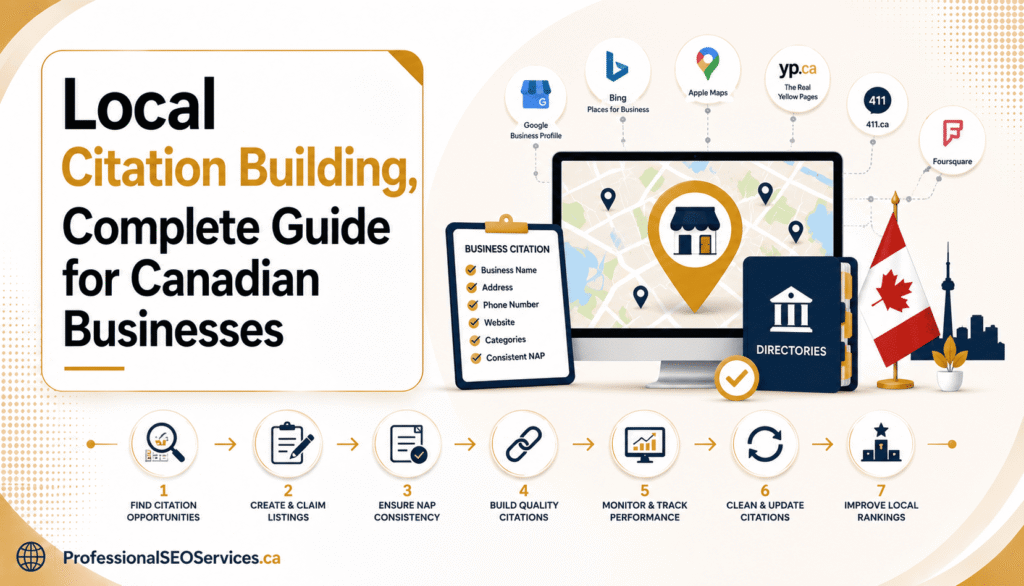
Your competitor with a clearly weak website beats your top-notch website on the map pack using local citation building- a nightmare, honestly. But the real difference isn’t the website at all its about working on valid local citations. This guide covers what local citations are, why they matter more than ever with AI search in the mix, and discusses strategies for local citation building in detail.
What Is a Local Citation?
Before exploring local citation building, let’s uncover what local citations are. Don’t get confused by this big word, “Local Citations”, its actually an online mention of your business’s Name, Address, and Phone number, or call it NAP. You can see citations on business directories, social platforms, industry-specific sites, and data aggregators. They are different from backlinks because you don’t have to link them back to your business. Simply mentioning your correct NAP on a trusted source signals to Google. This way, search engines verify your business is real and established.
Why Local Citations Still Matter in 2026
According to Google’s local ranking factors guidelines for performance, how established and famous your business is is one of the three local ranking factors, alongside relevance and distance. Your business performs well based on the consistency of local citations.
AI-powered search. Platforms like Google’s AI Overviews, ChatGPT Search, and Perplexity cannot verify if the business is real or not. Instead, these AI search engines take their data from directories, social profiles, and citation databases to decide which business is worth recommending.
Likewise, when your business is consistently present on dozens of verified sources make it easy for AI-driven search engines to find and list your business. No matter how good the actual business is, it gets ignored by these tools when business information is patchy or conflicting.
The NAP Consistency Problem During Local Citation Building
Inconsistent listings cause more damage to local citation building than missing listings. Common examples of poor local citation building include:
- An “St.” on one platform and “Street” on another.
- A phone number listed with a country code in one place and without it elsewhere.
- An old address still showing up on a directory years after a move.
Every inconsistency sends a small uncertainty signal to Google; if it gets out of hand, it causes enough drag in local rankings.
Local Citation Building: Where to Start
Local citation building becomes easier when you follow the right track, and our guide gives you a whole map of what to do and how to do it.
Tier 1: Non-Negotiable Citations
No matter which industry you are in, if you are running a local business in Canada, you need to work on these local citation-building mediums:
- Google Business Profile: the foundation everything else builds on; complete every field, not just name and address
- Bing Places for Business: feeds directly into Microsoft Copilot and Bing Maps, a segment many local SEO efforts overlook
- Apple Maps Connect: critical given how much “near me” search volume comes from iPhone users
- Facebook Business Page: crawled by Google and referenced by AI platforms; needs consistent NAP and active posting
- LinkedIn Company Page: particularly valuable for B2B and professional services in Canada
Tier 2: Canadian and Industry-Specific Directories
After working on local citation building on different platforms like Apple Maps Connect, Bing Places for Business, Google Business Profile and others, expand into directories relevant to your market and industry:
|
Category |
Examples |
|
General Canadian directories |
Yellow Pages Canada, Canada411, BBB Canada |
|
Healthcare |
RateMDs, Healthgrades |
|
Legal |
Lawyer Locator, Canadian Bar Association listings |
|
Restaurant/hospitality |
TripAdvisor, OpenTable |
|
Real estate |
Realtor.ca, Zillow |
|
Trades/home services |
HomeStars, local Chamber of Commerce directories |
Build local citations on directories with real domain authority and genuine traffic instead of volume. A few quality local citation-building listings can beat a large volume of low-value directory submissions.
How to Build Citations: A 5-Step Process
Local citation building becomes easy when we explain the whole process of gaining domain authority in just 5 steps:
1. Standardize your NAP format first
Choose one style for how your business name, address and phone number will appear on different directories and platforms. Write down everything, considering the same abbreviations and spacing before creating listings.
2. Audit what already exists
The second step in local citation building pay attention to your business name and phone number while searching to find correct mentions. Check for inconsistencies before adding anything new. Tools like Moz Local can automate this across major data aggregators, as outlined in Moz’s guide to local citations.
3. Fix inconsistencies before building new ones
For example you add 30 new local citations across business directories when you already have 20 with an old address cause a big issue. You need to replace the old address with the current address and choose the correct sequence every time.
4. Complete Tier 1, then Tier 2, systematically
To make it easy, you can track all the local citation building submissions in one spreadsheet listing them as:
- Directory Name
- URL
- Date
- Login
- NAP
This way, you will know how many listings are currently live.
5. Add Local Business schema to your website
A clear strucuted data on your website directly sends a signal to Google and AI crawlers about what your official NAP information is. Also, it makes a loop between your website and your directory listings.
What are Local Citation Finder and Checker Tools?
The whole local citation building process becomes easy when you use tools to find business listings, correct incorrect information and identity missing citations across multiple directories.
- Find Existing Citations: Locate your current business listings.
- Check Business Details: Find incorrect names, addresses, or phone numbers.
- Identify Missing Listings: Discover directories where your business is not listed.
- Save Time: Check multiple directories from one place.
- Audit Regularly: Review citations every few months to catch changes early.
Businesses usually run citation audits to keep their information accurate and consistent across the internet.
Avoid All These Mistakes While Building Local Citations
You already know what local citation building is and how to do it right, but you need to know what not to do ever:
- Inconsistent NAP data: the single most damaging and common error, especially for businesses that have moved or rebranded
- Incomplete listings: Adding just a name or phone number in a directory is not enough; it sends weak signals compared to full information.
- Duplicate listings: Two entries for the same business on the same platform split authority and confuse search engines.
- Wrong or overly broad categories: reduces relevance for the specific searches that matter most
- Building new citations before fixing old ones: compounds inconsistency rather than resolving it
How Long Does Citation Building Take to Work?
For new citations, it usually takes up to a week to index and bring changes to your rankings. However, if you fix an existing inconsistent listing with accurate information, it brings good results much faster. Because correcting the mistakes in your listings removes the conflicting signals rather than adding new ones. A comprehensive citation profile built from a low base generally takes a few months of consistent work before the ranking impact becomes clearly measurable — consistent with how local SEO timelines generally play out.
Bottom Line
Local citation building is slow, and unglamorous work with genuinely high returns. That’s why you need to keep consistent NAP on all the platforms, directories and the web. You will soon start seeing positive rankings on both Google and AI search when your local citations show their magic. Not sure where your local citations stand? Start with our “Free” SEO Audit today.
Frequently Asked Questions
How many citations does my business actually need?
You must know that volume does not matter; only the quality of citations and their consistency matters. Few high, consistent citations on authoritative directories work better than low-quality, inconsistent citations in large quantity.
Does NAP consistency really affect rankings?
Yes. Inconsistent business information across directories creates conflicting trust signals that can suppress local rankings, a factor both Google and AI search platforms weigh.
Do citations still matter now that AI search is growing?
Yes, local citations after Ai-driven search tools matters more than ever. Because these AI search engines pull data from business directories instead of your websites to define whether you are trustworthy or not, that’s why it is one of the ranking factors for AI searches; local citation building is important even now.
